Opinion · Four questions about AI
That Aha Flash of Dopamine from AI
An answer suddenly makes sense, and you want to keep going. I want us to enjoy that moment while giving the explanation a chance to fail.

Enjoy the explanation, then examine it
Consider the moment when an AI answer makes a difficult idea seem manageable. A connection appears. A confusing problem takes a shape you can work with. You want to ask the next question because the conversation has become rewarding.
I use dopamine in the title as shorthand for that rewarding feeling. A feeling alone cannot tell us whether dopamine changed, and the studies discussed here did not measure the brain of someone receiving an AI answer. I want to keep that distinction clear because an attractive explanation of the brain can become another answer we accept too quickly.
The pleasure itself does not trouble me. I want learning to contain discovery. An explanation that helps you stay with a difficult subject can be valuable, and a new connection can give you somewhere useful to begin. My concern is the decision that follows the feeling. Do you test the idea, or does its sudden clarity become sufficient evidence that it is correct?
You can enjoy an answer and still ask it to withstand scrutiny. That is the habit I want to encourage. It gives you a way to use the enthusiasm without letting it decide which claims deserve your trust.
A completed answer leaves another question
Research published on 26 October 2026 distinguishes AI-assisted task performance from subsequent independent knowledge. It provides a timely reason to test what remains after an explanation disappears.
Suppose an assistant explains a concept you have struggled with. You follow each sentence and feel relieved. Close the answer and try to explain the idea using a different example. That proposed check asks whether you can work with the concept, including where it applies and where it stops being useful. Re-reading a persuasive explanation asks less of you.
I do not expect every useful encounter with AI to become a formal lesson. Sometimes you need a translation, a draft or a reminder. But if you intend to make a consequential decision from the explanation, or claim that you now understand the subject, I think you owe yourself a check that does more than reproduce its wording.
The feeling and the finding need separate labels
Schultz, Dayan and Montague's foundational research linked primate dopamine-neuron activity with changes or errors in reward expectations. It helps explain why dopamine belongs in a discussion of learning and reward. It does not measure the pleasure of using AI or make a pleasant experience a neurotransmitter reading.
A 2020 insight study analysed 30 participants after exclusions from 44 recruited. Researchers recorded brain electrical activity while people solved anagrams and identified an insight-related reward signal that varied with reward sensitivity. This was EEG evidence, not a direct dopamine measurement, and it concerned a particular task.
The relationship with correctness also needs care. Danek and Wiley's study of 70 participants explaining magic tricks found that 417 of 1,124 incorrect solutions, about 37%, received aha ratings above the mean for correct solutions. That is a share of incorrect solutions, not a claim that 37% of all insights are wrong. Correct solutions still tended to receive stronger aha ratings overall.
I take a practical lesson from those limits. A feeling can be information about your experience without being the final judge of the explanation. If a connection seems promising, give it a task. Ask it to explain an unfamiliar case, support a calculation or identify a condition under which it would fail. You can then inspect more than your first impression.
An answer may be easy to read and logically consistent while relying on a false premise. Even a sound argument may not apply to your situation. I would check the underlying facts and ask whether the conditions match the decision in front of me.
I would also look at the question I asked. Suppose you ask an assistant why a colleague is resisting change. A satisfying explanation might make that assumption feel settled before you have checked whether it is true. Perhaps the colleague lacks time, sees a defect, or has information you have missed. Rewrite the question to leave those possibilities open, then ask what evidence would distinguish them. This is a different check from remembering an explanation: you are examining whether the conversation started with a fair description of the problem.
The useful answer may also be the one you enjoy least. An assistant might point out that your question has no clear evidence behind it, or that the available information supports several explanations. I would resist asking for a more decisive version merely because uncertainty feels unfinished. If the evidence is incomplete, a question for the next person may be the best thing to take away from the conversation.
My concern about Cognitive Debt starts when verification and learning are repeatedly postponed as work is delegated. Some postponement is sensible: you cannot study every subject in full before using anyone's help. The difficulty comes when you remain responsible for a decision but have no way to examine the reasoning behind it. I would ask what you need to understand now, and what can safely wait.
I would not demand that you reconstruct everything alone. Use another source, a small calculation, a worked example or a qualified person. The check should be independent enough to reveal an error, rather than simply asking the same assistant to say the same thing with greater confidence. A second AI response may help generate questions, but its agreement needs a basis you can examine.
Before a convincing chart reaches a Jamaican farm
Consider a hypothetical grower in St Elizabeth, Jamaica, asking an assistant to explain a rainfall chart before planning work. The explanation may feel clear because it converts colours and probabilities into an ordinary sentence. Before acting, I would ask which location and period the chart describes, when it was issued and whether the source supports the specific decision being considered.
The UNCCD's Jamaica drought-tool entry points to climate information intended to support decisions about crops, irrigation and water management. I would begin with the applicable original information and its qualifications, rather than treating a generated explanation as a substitute for the source.
For the St Elizabeth example, ask the assistant to show the chart's date and geographic scope, then check those details directly. A seasonal statement and a decision about work on a particular day need different evidence. Seek appropriate local advice when the decision warrants it. The explanation should preserve what the chart can establish and the questions it leaves open.
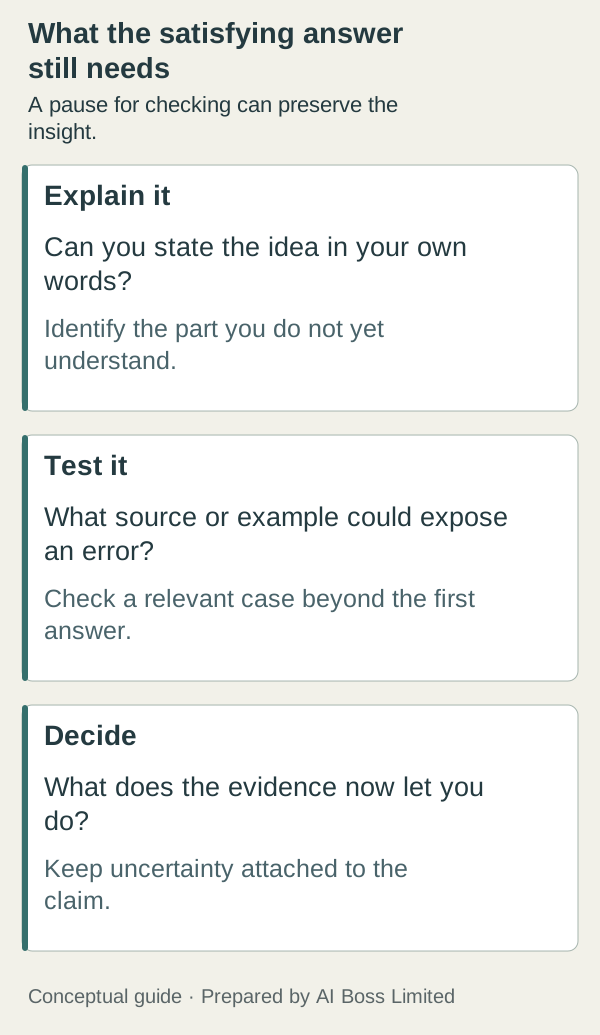
Do not make suspicion your only response
Constant checking can make learning cumbersome. If you interrupt every small discovery with a lengthy investigation, you may lose the willingness to explore. I would make the check proportionate to the claim and the consequences. An idea for a fictional story can remain an experiment. An explanation that changes a financial, health or safety decision needs stronger support.
One workplace risk is a premature handover. A colleague receives a confident recommendation without the source, uncertainty or assumptions needed to evaluate it. The colleague and the people affected by the decision then carry the consequences. Preserve those details before the answer travels. If an important premise cannot be verified, say so at the point where someone is being asked to act.
Give the next aha a small test
I suggest a modest exercise for the next explanation you want to remember. Use it to find a gap worth returning to, and keep the stakes low enough that a mistaken first attempt will not harm anyone.
- Choose three explanations to examine by 1 November 2026. Pick material relevant to something you want to understand, with an authoritative source or knowledgeable reviewer available. Before accepting an answer, write what you think it means and identify the claim you would rely on. Keep sensitive work out of an unapproved tool.
- Check understanding by 5 November. After a day away from each explanation, describe it without reopening the conversation and apply it to one different example. Compare your account with the source or reviewer. Record errors, missing conditions and questions. Three examples can reveal a useful gap; they cannot establish a general change in your cognitive ability.
- Use the gap to choose your next question. Ask for a different explanation of the part you could not reconstruct, then verify the answer. Where the issue is a factual claim, go back to the original evidence. Where it is an unclear decision, clarify the assumptions and consequences before asking for another polished response.
I would keep a short note of what changed after the check. Perhaps the initial explanation was sound and you can now use it independently. Perhaps you discovered a missing condition that changes the answer. Either outcome makes the next conversation more useful because you have a specific question to bring to it.
Questions about the moment of insight
Does an aha feeling mean I have learned nothing?
No. A moment of insight can accompany understanding. The useful next step is to examine what you can explain or apply afterward. Choose a fresh example or identify a limitation without copying the original wording. Your performance on that task supplies information the feeling alone cannot provide.
Is asking another AI enough to verify an answer?
It may help reveal a disagreement or a missing question, but agreement between outputs is not an independent source record. Ask what supports the claim and inspect that material. For a calculation, reproduce the relevant step; for a consequential specialist decision, involve someone qualified to assess it.
How should I record uncertainty without making every note long?
Write the claim, its source, the important condition and the unresolved question beside it. Include the date when the fact can change. A brief note is useful if another person can tell what they may rely on and what still requires a check before action.
What if the explanation is an analogy?
Ask which features of the analogy correspond to the subject and where the comparison breaks down. Then return to the underlying mechanism or evidence. The familiar example can help you begin, while the comparison's limits tell you where further evidence is needed.
Sources and further reading
- Generative AI and the temporary upskilling of knowledge workers
- A Neural Substrate of Prediction and Reward
- An insight-related neural reward signal
- What about False Insights?
- Drought Forecast Map; Farmers Bulletin: Jamaica
- Adrian Dunkley methods and FAQ
Opinion. Sources checked on 29 October 2026. Research findings are distinguished from the author’s recommendations. Examples and proposed exercises are labelled in the text.
Also published on AI Boss HQ. Related work: StarApple AI and StarApple Analytics.