Opinion · Four questions about AI
Am I Worth as Much Now?
When AI can produce work you were paid to do, the question becomes personal. I want us to discuss income and bargaining power without pricing a person.

The question deserves a straight answer
If an AI system can produce in minutes something you spent years learning to do, I can understand why you would ask whether you are worth as much now. Telling you to embrace change does little to answer it. You may be thinking about a mortgage, a school fee, a client who wants a lower price or a role you hoped would last.
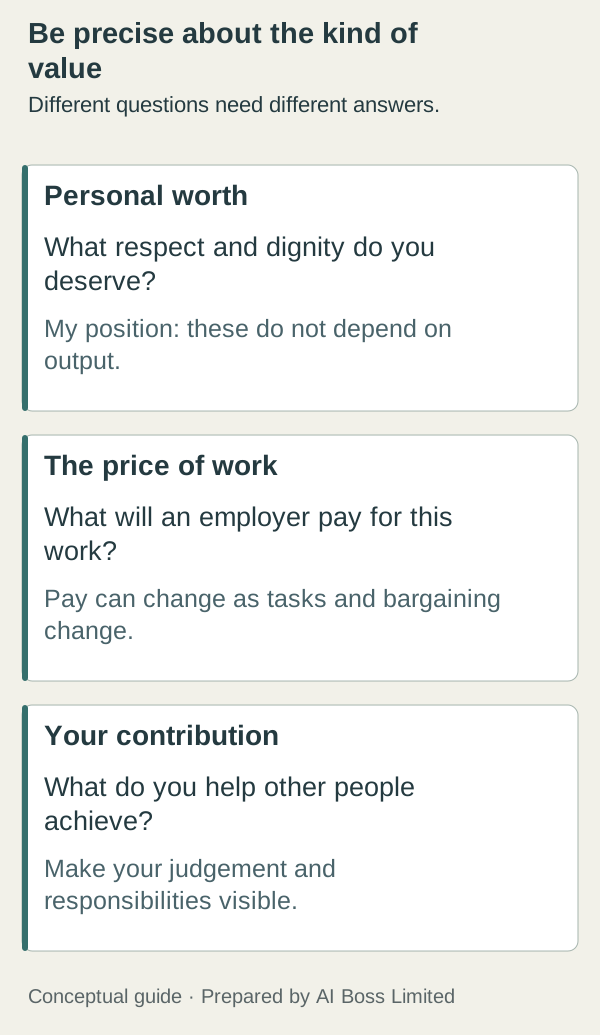
I believe a person's worth exceeds the price of a task. That is a moral position I am willing to defend. It does not settle what an employer will pay, what a client will buy or how much influence you have over either decision.
The difficult possibility is that a skill remains valuable while the price of producing a particular output changes. You may have worked hard to acquire that skill. The effort matters to your history, but a buyer can still ask what they need to spend today. I do not think we help people by pretending that effort makes every existing business model permanent.
I also resist the rush to write a person off after seeing one task automated. A job includes decisions about what should be done, how it should be checked and what happens when circumstances change. We should examine those responsibilities before making a judgement about the person doing them. That examination may support a different role, a different price or a different way to organise the work.
Better tools do not set your wage automatically
On 6 October 2026, Anders Humlum and Emilie Vestergaard described research in one national labour market. Surveys of about 25,000 workers in 11 AI-exposed occupations were linked to employment records through December 2024. They found no average effect of chatbot adoption on earnings or hours, and ruled out effects larger than 2%.
That finding does not tell you what your next contract will be worth. It does make me wary of the easy promise that learning an AI tool will automatically raise your salary. Your employer or client still decides what to buy and what to pay. Demand for the work, your responsibilities and your ability to negotiate will affect that discussion. Start with those conditions in your own workplace.
If you have become faster, follow the benefit through the work. A customer might receive a better service, your team might accept more assignments, or checking the extra output might fall to somebody else. Ask which of those changes your manager can recognise and reward. Otherwise, improved speed may simply become a new expectation that you will absorb more tasks.
What has become easier to produce?
The ILO's 2025 exposure index places one in four workers globally in occupations with some generative-AI exposure; 3.3% of employment falls in its highest category. Exposure describes potentially affected tasks. It is not a count of redundancies, and it gives no personal verdict on your future income.
A different study shows why concern about the price of output is reasonable. Shakked Noy and Whitney Zhang's experiment with 453 professionals concluded that “ChatGPT substantially raised productivity”: access cut average time on specified writing tasks by 40% and raised assessed quality by 18%. Those figures concern particular assignments. They do not establish the market price of a whole job.
If a client buys an output that has become easier to produce, I would expect them to question the old arrangement. That is a possibility to prepare for. You might lower the price, serve a different need, take on more work within a sensible capacity limit or change what the agreement includes. Which choice makes sense depends on the evidence about your service and your customers.
What I would avoid is selling an undefined quality called being human and hoping the phrase does the negotiating. Explain the judgement you contribute. Show the ambiguity you resolved, the error you caught or the consequence you anticipated. If the client can obtain the same accepted result elsewhere for less, take that information seriously and reconsider the offer.
I use the term AI Shadow Work for the cognitive labour involved in using AI well that formal assessments can miss. A manager who sees only the finished draft may miss how you chose its evidence, checked it and decided it was ready to use.
Showing that work does not guarantee higher pay. It gives an employer a better basis for deciding what to train, recognise or redesign. I would want a performance conversation to distinguish between someone who produces many drafts and someone who delivers work others can use without an expanding correction queue.
If most of your pride rests on being the fastest person to produce a particular output, a faster tool can feel like a verdict. Give yourself permission to revise that definition of achievement. Learning to make sound decisions about unfamiliar assistance can become part of your work without erasing the knowledge that brought you here.
What the restaurant is buying
Consider a hypothetical designer preparing a restaurant's menu and launch materials. The owner wants a premium feel, low printing costs and type older customers can read easily. Imagine that an AI draft looks attractive but illustrates a dish with an ingredient the restaurant does not serve. The designer must check the actual dish with the client, correct the image and test whether the menu works on the intended paper and equipment.
The finished design is only part of what the owner is buying. Someone has to resolve a brief whose demands may conflict, notice the mismatch and get a usable result to the printer. If the designer simply forwards the first attractive image, those responsibilities fall to the owner. If the designer accepts them, the proposal should say what that includes and where the client's approval is needed.
AI may have reduced the time spent on an early draft. Be honest about that. A lower fee for that part of the work may be reasonable, while checking the dish and testing the print still need doing. Keep the agreed brief, an approved sample and the reasons for the final choices. They support a discussion about this assignment; the studies above do not establish what its fee should be.
I cannot promise that good judgement will protect your job
An employer may still reduce a role, a client may still cut a budget and a capable person may face a difficult transition. I cannot promise that good judgement or continued learning will protect a job. Understanding your contribution can help you decide what to offer, what to learn and which terms to seek, while you also prepare for decisions you cannot control.
There is a risk for employers too. If the organisation rewards only visible output, people may concentrate on producing more while hiding the effort needed to check it. Customers and downstream colleagues then carry the errors. A fair review should examine accepted outcomes, correction work and responsibility for exceptions, with staff able to explain problems without being penalised for disclosing them.
Use examples you have permission to share when showing how you work. A portfolio that exposes a client’s records can undermine the contribution it was meant to demonstrate. The reader should be able to understand your decision without seeing information you were trusted to protect.
Bring the work into the pay conversation
Before your next review, look at a few comparable pieces of work from beginning to acceptance. What did you decide? What did you check? Where did somebody else have to intervene? Include preparation and correction time alongside the time spent drafting. If an agreed baseline exists, use it; if task difficulty changed, record that too. A small collection of examples is a starting point for discussion, not proof of a general productivity gain.
Then ask your manager or client which contribution they want to buy more of. Bring the records you are authorised to share, including a case where assistance disappointed you. That gives the conversation a chance to address the work as it happened. It also lets you ask who benefits from the extra capacity and whether your responsibilities or terms should change.
If you are the manager, say what you can approve. Do not offer vague recognition in place of a pay discussion or promise a reward outside your authority. If a pay increase is unavailable, explain the constraint, agree any useful training or role changes you can provide, and set a review date you intend to honour. The employee should be able to judge whether the commitment was kept.
You may leave that conversation wanting a different arrangement. You may discover that a part of your offer has lost its market, or that you have been carrying work nobody recognised. Neither discovery will be easy. Both give you something more useful to work with than the instruction to become indispensable.
Questions for your next work conversation
Should I tell a client that I use AI?
Follow the agreement and any applicable disclosure requirements, and discuss use when it affects confidentiality, rights, quality assurance or what the client reasonably expects you to deliver. Explain the checking you provide. Do not describe a generated draft as independently verified work before that verification has happened.
What if I am paid by the hour?
Discuss how assistance changes the scope and billing arrangement before assuming the previous number of hours still applies. Consider whether the client needs a defined outcome, continuing availability or a limited assignment. Any revised fee should reflect the agreement you reach, not an undisclosed change in how time is recorded.
Sources and further reading
- Still waters, rapid currents: Early labor market transformation under generative AI
- Generative AI and Jobs: A Refined Global Index of Occupational Exposure
- Experimental evidence on the productivity effects of generative artificial intelligence
- Adrian Dunkley methods and FAQ
Opinion. Sources checked on 30 October 2026. Research findings are distinguished from the author’s recommendations. Examples and proposed exercises are labelled in the text.
Also published on AI Boss HQ. Related work: StarApple AI and StarApple Analytics.