Opinion · Four questions about AI
Do Tokens Define Me in an Interview?
Ask me how I use AI, what I learned and what I checked. A consumption total needs that explanation before it can help you assess my work.

Ask what the number is meant to tell you
If you ask me in a job interview how many AI tokens I used last month, I want to know what you hope the number will tell you. Are you asking whether I experiment, whether I can manage a budget or whether I can do the work you need? Those are different questions. I would like the opportunity to answer the one that matters to the job.
I have no objection to discussing how I use AI. A candidate who wants responsibility for these systems should be ready to explain their experience. A large consumption total may reflect useful experimentation. I would still want to hear what the candidate tried, what worked and what they learned before treating it as evidence of competence.
For a text model, tokens are units used to represent and process text, often words or parts of words. Token accounting has practical uses in managing costs and limits. A hiring decision asks something further: what can this person contribute, how do they recognise a mistake and what will they do when the first answer is inadequate?
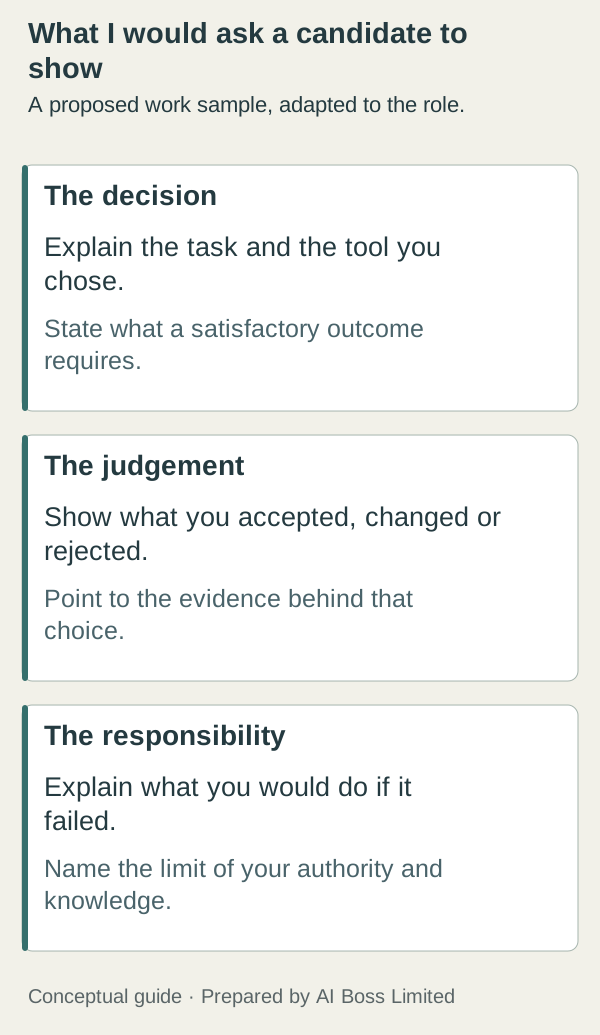
I would welcome an interview that makes those questions concrete. Give me an appropriate task, explain the constraints and let me show my choices. Then ask why I accepted one result and rejected another. You will have something more useful to discuss than whether my monthly total looks impressive.
Even a usage metric needs judgement
Amazon's engineering memo published on 27 October 2026 is more nuanced than a rejection of usage measures. It warns against turning token consumption into a target, while allowing careful interpretation of input metrics alongside outcomes. The memo also treats work that gains little from current AI tools as information worth examining.
I agree with the distinction. A usage total can prompt a sensible follow-up. An interviewer might ask why a candidate used an assistant extensively for one project and barely touched it for another. The answer could show curiosity, cost awareness or a reasoned decision about suitability. A number becomes more informative when the person explains the work behind it.
My objection is to skipping that explanation. If the intended signal is experimentation, ask what was tested and what changed. If the intended signal is efficiency, inspect the cost of completing an acceptable task. If the intended signal is learning, ask the candidate to explain what they can now do or understand. Each interpretation needs evidence that consumption alone does not provide.
I want to see the judgement in the work
Anthropic's AI Fluency Index examined 9,830 multi-turn Claude conversations from one week in January 2026. It identified iteration in 85.7% and explicit fact-checking in 8.7%. These are visible chat behaviours, not percentages of people who ever check facts. The classifier assessed 11 of a framework's 24 indicators, leaving other behaviour outside its view.
That measurement limit should influence the way we assess candidates. A person might verify a calculation in a spreadsheet, consult a source in another window or ask an experienced colleague. Their conversation record may omit that work. Equally, a message asking the assistant to double-check does not establish that an independent check happened. I want to examine the evidence, including what took place beyond the chat.
My term Shadow Literacy describes the judgement needed to spot an answer that sounds convincing but is wrong, know enough to verify it and decide what can safely be delegated. An interview can invite a candidate to demonstrate those abilities. Naming them is a starting point; the employer still needs an assessment suited to the role.
US Office of Personnel Management guidance on work samples describes assessing activities relevant to the job. It also cautions that the approach suits competencies expected on entry; skills the employer intends to teach may need different treatment. Applying that guidance to an AI-assisted exercise requires design and validation.
For example, I would ask a candidate to work from an approved packet of information containing one inconsistency. I would tell them that clarification is allowed. I would watch whether they notice the conflict, explain its importance and decide what evidence is needed before completing the task. The purpose would be to observe relevant decisions, not to spring a trick and reward whoever guesses the assessor's preferred phrase.
I would also ask about a rejected output. A candidate may have rehearsed their explanation of a successful final product. Discussing an unsuitable draft gives them a chance to show the criteria they used. It can reveal whether they understand why the output failed and whether the correction addresses the cause. The employer would still need to establish whether that discussion reveals something relevant to this particular role.
If you are the candidate, bring an example you are authorised to share. Show the initial objective, a material choice, the evidence you checked and the result you can support. You do not need to portray every experiment as a success. A clear account of why you stopped using a tool for a task can show more thought than a claim that you use AI for everything.
A fair exercise for a Jamaican vacancy
Consider a hypothetical Jamaican employer recruiting an analyst who will support local customers. I would give candidates the same approved records, the same permitted tools and an equal usage allowance for the assessment. Personal access to a paid account should not become an unannounced prerequisite when the employer can provide the environment required for the exercise.
The task could ask a Kingston-based analyst to arrange a handover with a New York client at the start of November. Jamaica keeps its clocks five hours behind Coordinated Universal Time throughout the year, while New York's daylight-saving period ends on 1 November 2026. I would supply the official time guidance and ask the candidate to confirm the local time in each city for appointments before and after that change. The assessment would examine whether they check dates and assumptions before promising availability. A polished booking that treats Jamaica as changing its clocks with New York would expose a mistake that matters to the client.
I would ask a reviewer familiar with the work to help define acceptable answers and errors that matter. A generic polished response should not receive credit for ignoring the supplied Jamaican context. These are proposed design choices for a local vacancy, not evidence that a particular test has been validated for Jamaica or that all candidates should face the same task across different jobs.
My alternative needs scrutiny too
An interview task can look sensible while measuring the wrong thing. It may reward familiarity with one interface, fluency under time pressure or the assessor's preferred writing style. A candidate who could do the work well with appropriate support may perform poorly in an artificial setting. Those risks remain when we replace a token total with an exercise.
Employers should define the competence being assessed, make relevant adjustments through their established process and use trained reviewers with shared criteria. Avoid giving applicants unpaid assignments that the business intends to use as finished commercial work. Keep the exercise proportionate and explain how the output will be used.
Candidates also face a confidentiality risk when asked to prove past AI use. A chat history can include client information, personal details or material covered by an employer's restrictions. I would accept a permitted, edited example and a credible explanation of the missing context. A recruitment process should not reward someone for disclosing information they were trusted to protect.
Change one part of the interview
If you are responsible for hiring, try the exercise with colleagues before making it a requirement for applicants. The first question is whether it asks people to demonstrate something the job needs.
- Write the capability you need by 2 November 2026. Describe a task the employee must perform and the decisions they must make. Separate an entry requirement from a skill you will teach. If you retain a token-usage question, record what it is intended to reveal and the follow-up evidence required.
- Test the exercise with five willing colleagues by 5 November. Provide equivalent tool access and have two reviewers assess the work independently using the same criteria. Compare disagreements before discussing names or reputations. Five trials can reveal obvious design problems; they cannot establish predictive validity or fairness across applicant groups.
- Review the applicant instructions and data request. Explain permitted assistance, time expectations, confidentiality protections and how decisions will be scored. Ask whether someone could demonstrate the skill without revealing a previous employer's records or paying for access you failed to provide. Revise those conditions before the next interview.
If you are preparing for the interview, ask what the employer wants to learn from its AI questions. Offer a relevant example with a clear account of your judgement. An employer may still prefer a metric you consider weak. You can use that conversation to learn how the organisation intends to assess your work once you join.
Questions candidates and interviewers can ask
Should a candidate with a low token total explain it?
Explain the scope of your access and the tasks for which you used assistance, if relevant. Then show what you can do. Do not invent a higher total or imply experience you do not have. A credible limitation gives the interviewer a chance to assess learning needs honestly.
Can efficient prompting be part of an assessment?
Yes, where cost and usage constraints matter to the role. Define an acceptable result and examine the resources needed to reach it. A short prompt that omits essential evidence can be poor work, while a longer interaction may be justified by a difficult task. Evaluate the trade-off you actually need.
What if the job mainly involves learning new tools?
Provide a bounded unfamiliar task, an appropriate introduction and clear permission to ask questions. Observe how the candidate identifies a gap and checks progress. Keep that exercise separate from testing expertise they were never expected to possess, and assess its suitability before using it to reject applicants.
What should a candidate retain from an AI project?
Keep permitted records of the objective, important constraints, checks, revisions and outcome. Remove confidential content and respect the organisation's retention rules. A short explanation of one consequential decision is often more useful for discussion than an unfiltered conversation export that leaves the interviewer to infer your contribution.
Sources and further reading
- An update from Amazon engineering leadership on the role of the developer in the age of AI
- The AI Fluency Index
- Work Samples and Simulations
- Token counting
- Adrian Dunkley methods and FAQ
- Jamaica Tourist Board: General information, Time Zone
- NIST: Daylight Saving Time Rules, 2026
- Claude glossary: Tokens
Opinion. Sources checked on 29 October 2026. Research findings are distinguished from the author’s recommendations. Examples and proposed exercises are labelled in the text.
Also published on AI Boss HQ. Related work: StarApple AI and StarApple Analytics.