
Antonio Gherardi, Festival decoration, late 17th century. The Metropolitan Museum of Art, public domain.
On August 3, 2026, Barbados's National Cultural Foundation (NCF) issued a statement about YouTube. Videos of Grand Kadooment, the costumed parade that closes the six-week Crop Over festival, were circulating with titles, thumbnails and formats built to look like live broadcasts. The NCF said it had not produced, commissioned, authorised or endorsed any of them, and pointed the public to its verified accounts, @thencfbarbados and @lovecropoverbb, and to its authorised broadcast partners.
Seventeen days later and about 700 kilometres south, the Caribbean Broadcasting Union (CBU) closed its 57th Annual General Assembly in Georgetown. The union, whose members span the English, Dutch, French and Spanish-speaking Caribbean, adopted a rule for its annual media awards: entrants who use a large language model must say so, and AI-generated material may not exceed 20 percent of a submission. Guyana's President Mohamed Irfaan Ali told delegates: "Never allow the technology to become the journalist."
As chairman of the Caribbean AI Risk Management Council (CAIRMC), I read the two events together. Tourism and culture, the sector with the least capacity to fight synthetic content, met the problem first. The broadcasters wrote a rule for their own awards. Nobody has yet written one that reaches the accounts that made the fakes.
The fakes were built to pass as official coverage
Crop Over takes bandleaders, costume designers, artisans, musicians, production crews and masqueraders most of a year to prepare. The videos the NCF flagged borrowed that work's look without any of the people. Their titles and descriptions were written to read as live or official footage to someone scrolling past with no reason to check.
Barbados Tourism Marketing Inc had been working on authenticity from the other side. It brought just over 50 international journalists, content creators and influencers to the final stretch of Crop Over 2026 and set up interviews with historians, artisans and cultural practitioners. That programme cost money and planning. The synthetic version of the same festival cost its makers close to nothing, and nobody knows how many people watched it.
Crop Over is worth BDS$80 to 100 million a year
Estimates of Crop Over's annual value run from 80 to 100 million Barbadian dollars, a figure that traces back to former prime minister Freundel Stuart and has been repeated in Barbados Today's coverage. That is under one percent of GDP, well below the 4 to 6 percent attributed to Trinidad and Tobago's Carnival, but large for an island of Barbados's size. The Central Bank of Barbados credited a revival in Crop Over tourism with part of the economy's estimated 4.4 percent growth in 2023.
That money depends on visitors trusting what they see before they book. Two 2026 surveys show how weak that trust already is:
- Talker Research, June 2026 (2,000 American travellers, commissioned by the Tennessee Department of Tourist Development): only 5 percent picked every real destination photo out of side-by-side comparisons with AI images. 70 percent said they rely on photos and video to choose a destination, and 74 percent would not book without seeing them. Tennessee's response was a "Real Seal" certifying that its own tourism imagery is not AI-generated.
- McAfee, March 2026 (1,000 American travellers, part of a six-country sample): 38 percent had met a travel-related scam, 41 percent of those lost money, and 48 percent of that group lost more than 500 dollars. Tripadvisor was impersonated about three times as often as Kayak, Expedia or Booking.com.
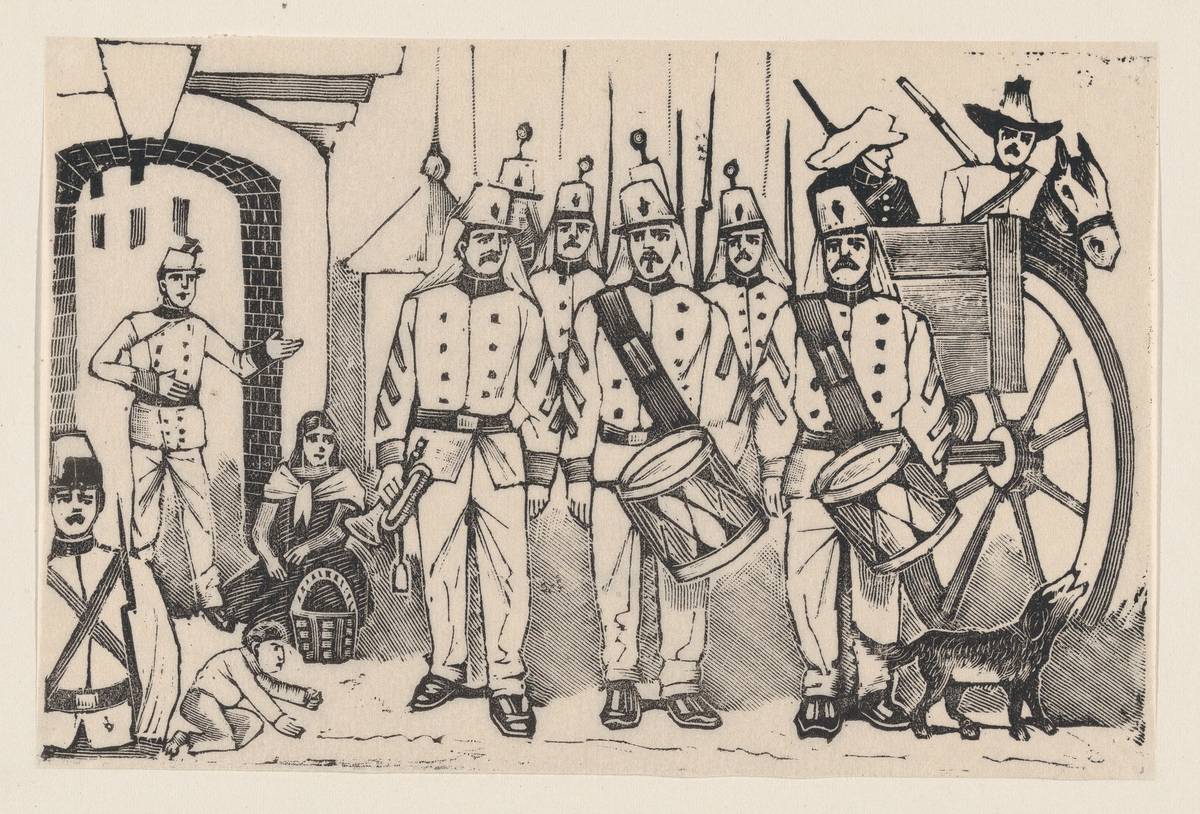
José Guadalupe Posada, A marching band standing in a street, illustration from 'La gorra del cuartel', ca. 1880–1910. The Metropolitan Museum of Art, public domain.
Neither survey is about Barbados. Both describe the sequence the NCF was trying to break: a convincing fake, presented as official, seen before a real booking decision.
What the CBU adopted in Georgetown
The assembly ran from August 17 to 19 under the theme Caribbean Media and AI. President Ali asked the region to strengthen verification systems and adopt clear AI disclosure standards in newsrooms. Kwame McCoy, Guyana's Minister within the Office of the Prime Minister for Information and Public Affairs, went further in his keynote. He asked the CBU to set standards for AI disclosure, synthetic content and newsroom accountability, to build Caribbean datasets for AI systems trained mostly on data from elsewhere, and to train staff in data journalism and synthetic media detection.
The CBU turned part of that into two concrete outcomes:
- The awards rule. Its media awards drew more than 680 entries in 56 categories this year, up 25 percent. Every entrant must now disclose large language model use, and AI-generated material is capped at 20 percent of a submission.
- The Caribbean Media Viability Initiative. Launching in the fourth quarter of 2026, it will bring together broadcasters, publishers, independent producers, educators, regulators and technology platforms to draft a Caribbean Media Viability Roadmap on business models, AI and public trust, due to inform the CBU's 58th Assembly in August 2027.
The Core Argument
The CBU rule has a threshold, a disclosure requirement and an enforcement point: a prize its members want to win. It has no jurisdiction over accounts outside its membership, which is where the Crop Over fakes came from. A rule on how member broadcasters use AI does not give the public a way to check whether a video about the Caribbean is real.
The gap is verification for content from outside accounts
The accounts behind the Kadooment videos have no membership to lose and no award entry to disqualify. The same is true of a fake tourism board page, a fake ministry account or a fake bank profile, and the Caribbean has seen each of those in the past twelve months.
Caribbean media leaders already understand the problem, as McCoy's keynote shows. What the region lacks is a verification layer that sits above any one institution's rules. The nearest existing model is the C2PA specification from the Coalition for Content Provenance and Authenticity, which attaches a tamper-evident record of origin to an image or video when it is captured or published. With that in place, a viewer checks the file itself, not a membership list.
The Numbers Behind the Warning
- August 3, 2026Date Barbados's National Cultural Foundation publicly denied AI-generated Grand Kadooment videos were real
- 17 daysTime between the NCF's warning and the CBU's AI disclosure rule
- 20%Maximum AI-generated content allowed in a CBU media award entry
- BDS$80-100MEstimated annual economic contribution of Crop Over to Barbados
- 4.4%Barbados's estimated 2023 growth, which the Central Bank linked in part to Crop Over's tourism revival
- 5%Share of travellers who identified all real destination photos against AI fakes (Talker Research, June 2026)
None of this needs new technology. Provenance and watermarking tools exist, and Tennessee showed in the same news cycle that a state tourism department can launch an authenticity certification within weeks. The piece I am least sure of is enforcement: provenance marks prove where a genuine file came from, but they do nothing to stop a fake being posted, and platforms still decide how fast a reported fake comes down.
No confirmed losses from the fake Kadooment videos are on the public record, beyond the correction the NCF had to issue. The next test comes quickly: Junkanoo in the Bahamas on 26 December, then Trinidad and Tobago Carnival in February 2027.
A media rule that binds only the people who joined the association is progress. The accounts that faked Barbados's festival were never on anyone's membership list, and the next verification standard the region builds has to reach them too.
- Adrian Dunkley, AI Boss
What Caribbean festival and media bodies should do before the next season
- Festival organisers (the NCF, Trinidad and Tobago's National Carnival Commission, Junkanoo and Jamaica Carnival organisers): publish one page on your own website listing every official account and broadcast partner, at least 30 days before the season opens, and pin a post linking to it on each account.
- Tourism boards, starting with Barbados Tourism Marketing Inc: attach C2PA Content Credentials to official photos and video from the next campaign onward. Adobe's tools add them at export, so the first step is a settings change for the in-house team and a clause in agency contracts.
- Festival media teams: assign one person during the season to search YouTube, TikTok and Facebook daily for festival-name uploads and file impersonation reports the same day. Keep a log of links and report dates as evidence.
- The CBU: invite tourism boards and ministries of culture into the Caribbean Media Viability Initiative when it convenes in the fourth quarter, so the roadmap covers public verification as well as newsroom practice.
- Member broadcasters: extend the awards rule to your daily output with an on-screen label for any AI-generated footage. It costs nothing and gives viewers a reference point for what disclosed AI looks like.
Frequently Asked Questions
How can I check whether a Caribbean festival video is real?
Start with the uploader: compare the account name and handle with the official list on the organiser's own website, not with a link in the video description. On YouTube, open the description and look for the "Altered or synthetic content" label, which creators must apply to realistic AI video. For a still or keyframe, run a reverse image search with Google Lens to see where it first appeared. Warped costume details, crowd faces that blur on movement and signage with garbled text are common signs of generated footage.
How does an organisation get a fake video taken down?
YouTube lets an organisation report a channel for impersonation through its impersonation complaint form, and a rights holder can file a copyright takedown if the fake reuses its footage or music. A person whose face or voice is simulated can file a privacy complaint asking for removal. Facebook, Instagram and TikTok have equivalent impersonation reports. File from the official account where possible and keep the case numbers, because repeated reports on the same channel are handled faster.
What is C2PA, and what does it cost to adopt?
C2PA is an open technical standard, free to implement, that records who created a file and what edits were made, in a tamper-evident form known as Content Credentials. Adobe Photoshop and Lightroom can add Content Credentials at export, and a growing number of professional cameras can add them at capture. The main limitation is that some platforms strip the metadata on upload, so provenance works best alongside an official list of accounts, not in place of one.
What can a bandleader or small tourism business do on its own?
Post your own footage first and often during the season, with your handle burned into the video, so search results show genuine material. Keep your original raw files with their capture dates, because they are your proof of origin if someone disputes a clip. When a fake copies your costumes or name, reply publicly with a link to your official page and report the upload from your business account.
What is the Caribbean AI Risk Management Council?
The Caribbean AI Risk Management Council (CAIRMC) was established in January 2024 to build regional AI governance frameworks, certification, and alignment with standards including the EU AI Act, GDPR and Caribbean data protection law. Its Caribbean AI Risk Assessment tool, CARA, evaluates AI systems across technical, ethical, legal and societal dimensions. Adrian Dunkley chairs the Council, and its site is caribbeanairisk.com.