
TL;DR
CBS Aruba's August consumer price release, published on 28 September 2026, shows gasoline up 27.1% and diesel up 39.9% on a year earlier, while the electricity and water prices it tracks have not moved in any month since January 2025. That leaves a household with one lever, how much it uses. AI cannot lower the price of oil. It can show a household or a small business what it uses and when, warn when a month breaks the pattern, and help the utility forecast demand. The first step this week is a 28-day meter test that ends on 30 October.
What happened
CBS Aruba published its August 2026 consumer price index on 28 September, as awe24 carried it. Prices rose 0.5% on July and 2.7% on August 2025. In August gasoline rose Afl. 0.251 a litre, or 9.4%, and diesel Afl. 0.297, or 11.6%. Over twelve months gasoline is up 27.1% and diesel 39.9%. CBS puts the August average price of West Texas Intermediate crude at US$83.74 a barrel, up from US$79.32 in July, citing the US Energy Information Administration. Amigoe Aruba reported the 12-month rises of 27.1% for gasoline and 39.9% for diesel on 29 September.
The pump price behind them is on the record. 24ora reported that from 12 August 2026 gasoline cost 290.9 cents a litre, up 25.1 cents, and diesel 286.3 cents, up 29.7 cents. The island had been cushioning the rise. A government notice of 8 July 2026 said the subsidy was introduced when Middle East tensions pushed up oil prices, and that the government was keeping 50% of it as prices eased. 24ora noted that the August announcement did not mention a new subsidy. By our calculation from the CBS table, gasoline has gone from 210.7 cents in January 2026 to 290.9 cents in August, a rise of 38%, and diesel from 188.5 to 286.3 cents, a rise of 52%.
Utilities tell the opposite story. The same CBS release says electricity and water prices were unchanged from July, with the average electricity price per household at Afl. 263.67 and water at Afl. 168.73. Its table carries those two figures, and the energy charges of 34.31 cents a kilowatt-hour up to 500 kWh and 35.31 cents from 501 to 1,000 kWh, unchanged in every month from January 2025 to August 2026. One caution: CBS bases the electricity figure on a fixed average household use of 725.5 kWh, so these are prices, not bills, and the index cannot show whether a household used more.
24ora, reporting the July figures on 30 August, wrote that the tariff had not come down and that consumption could be said to have risen over the last two months, "debi na principalmente e calor inmenso cu a azota Aruba". It attributes the rise mainly to the immense heat that has hit Aruba. That is 24ora's reading, not a CBS measurement, and I found no published consumption figure to test it against.
The numbers
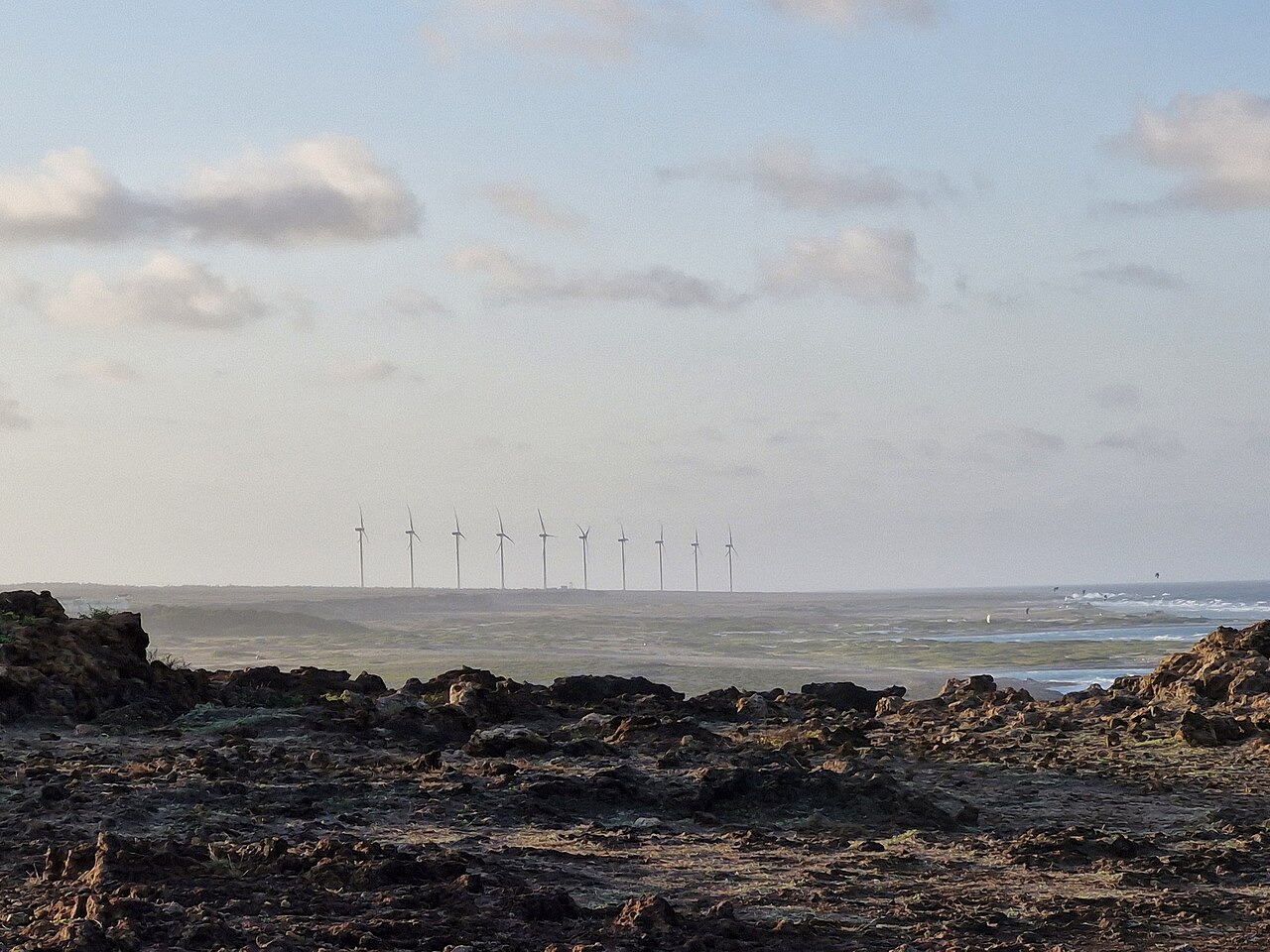
Aruba imports its fuel and the florin is pegged to the US dollar, so a higher dollar price for oil goes straight through to the pump. Electricity is exposed for a structural reason. The International Renewable Energy Agency's Aruba energy profile shows renewables supplying 5% of total energy supply in 2022, which is 599 of 12,658 terajoules, with energy self-sufficiency also at 5%. Aruba has a wind farm and some solar, and the imported remainder is priced in dollars. The region is in the same position: a World Bank release of 17 April 2025 says over 90 percent of power generation in the Caribbean depends on imported fossil fuels, and that only 11.6 percent of the region's electricity came from renewables in 2022. That is a share of electricity, a different measure from the IRENA share of total energy.
Water looks different. WEB Aruba reports an Infrastructure Leakage Index of 0.51, which it calls extremely low, across about 51,000 houses and businesses, and says its drinking water is pumped into seven storage tanks at Balashi with a combined capacity of 84,000 cubic metres. WEB's rate page, which I read on 2 October and which shows no effective date, lists household water at Afl. 7.90 per cubic metre in the 7 to 12 cubic metre band, Afl. 14.20 per cubic metre in the 13 to 20 band and Afl. 19.20 per cubic metre above 20, against Afl. 12.00 per cubic metre for commercial customers. The top household band costs 2.4 times the 7 to 12 band per cubic metre. WEB says only that the rate is multiplied by monthly consumption, and I did not confirm whether a higher band applies to the whole volume or only to the part above it.
For scale, the global problem that AI leak detection is sold against is large. A 2006 World Bank paper by Kingdom, Liemberger and Marin put it at more than 32 billion cubic metres of treated water leaking from urban systems a year, with another 16 billion delivered for no revenue. Liemberger and Wyatt, in volume 19 of Water Supply, 2019, estimated 126 billion cubic metres of non-revenue water a year, worth US$39 billion at a conservative US$0.31 a cubic metre, and judged the earlier estimates conservative. Aruba is not where that money is lost.

.jpg)
What this means in Aruba
I apply the method I call People First, Problem Second, AI Last. A test we suggest is to write the human need and the problem in two sentences each without using the word AI. The need: a family in San Nicolas and a guesthouse owner in Noord each have to know, before the next bill, how much of the rise they can control. The problem: a pump price up 38% since January, utility prices that have not moved in 20 months, summer consumption that 24ora says rose with the heat, and an oil price that is set in New York.
Neither sentence needs AI. The need is a figure a person can act on, and the problem is a bill that mixes a price they cannot change with a volume they can. AI comes last, as the tool that separates the two.
The island has already said that water and infrastructure strain matters. In the Aruba Strategic Tourism Master Plan 2026–2031 stakeholder sessions of 9 to 11 September, reported by 24ora, Minister Wendrick Cicilia's discussions gave particular attention to infrastructure, water management, nature conservation and housing for residents. Fuel and heat bills land in the same conversation.
What AI can do for a household
The cleanest evidence is old and plain. Hunt Allcott, writing in the Journal of Public Economics in 2011, analysed randomised field experiments at 600,000 treatment and control households across the United States, in which a utility mailed reports comparing each home's electricity use with its neighbours'. The average programme cut energy use by 2.0%. The study measured US households and paper letters, and it did not measure Aruba, heat waves or any AI system. I treat it as a benchmark for what feedback alone can do, and as our inference that a household shown its own pattern will usually trim some use.
AI adds two jobs to that. The first is explaining. A household types in its last twelve bills, kilowatt-hours and cubic metres as well as florins, and an assistant lists which months sit outside the household's own pattern and what changed in the weather or the tariff. The second is watching. The same assistant, or a simple script, compares this month's meter reading to the month's usual range and sends a message in Papiamento before the bill does.
The arithmetic stays in a spreadsheet. A language model can read a bill and write a clear summary, and it can also state a wrong total in a calm voice, which is why step four in the section on this week's actions exists.
The CBS table shows where the lever is. With electricity and water prices fixed for 20 months, any rise in a household's own bill came from volume, and volume is the one thing a household can measure daily on its own meter.
What AI can do for a small business
A restaurant, a guesthouse or a small farm pays for water by the cubic metre at a flat commercial or agricultural rate, and for electricity by a bill that mixes cooling, refrigeration and lighting. The question an owner needs answered is which of those loads moved. Feed monthly kilowatt-hours, cubic metres and the number of covers or room nights into a spreadsheet, and an assistant can compare cost per room night month by month and flag the month that broke the pattern. A guesthouse that sees water per room night jump in one month has a leak or a laundry habit to find. One that sees it flat has a different problem, and the oil price is not one it can fix.
A hotel group with metering on each wing can go further, using a forecasting model to tie daily use to occupancy and to the heat index. The same idea sits behind my earlier article on Curaçao's digitised weather archive, which covers Aruba's meteorological department as a partner: a record is the raw material, and a forecast needs a season of it.
What AI can do for the utility and the island
The standard pitch for AI in a water utility is leak detection, and the Liemberger and Wyatt figures show why it sells. For Aruba the pitch fits poorly. With an ILI of 0.51, WEB's distribution network is already tight, and a new acoustic-sensor programme would be chasing small gains. An ILI describes leakage in the utility's own network. A dripping tap or a leaking pool line behind a customer's meter does not enter it, and the customer pays for it by the cubic metre. Customer-side metering, with an alert when overnight flow never drops to zero, is where I would look first. That is our inference, and I found no published test of it in Aruba.
Electricity is where the island's fuel exposure sits. A model that predicts demand a day ahead from temperature and calendar, and predicts wind output from the forecast, lets operators plan which engines to run. Each unit of wind or solar that is scheduled well is a unit of imported fuel not burned, though I cannot give a figure for Aruba because I found no published test on its grid. It does not change the 5% in the IRENA profile. It changes how much of the existing renewable capacity gets used.
The decision behind both is the same one. A utility with half-hourly data and a forecast can offer households a warning before the bill and a business a reason to move a load, and it can show a regulator which part of a bill came from fuel and which from volume.
What a minister or the utility should ask for
Four requests cost little. Publish each tariff change with the unit, the formula and the end date. Break each bill into fuel, volume and fixed charges, so households can see what they control. Offer customers their own meter data in a form a spreadsheet can read. And require any vendor selling a forecasting or bill-analysis product to report its accuracy on Aruban data, because a score from Texas says little about a Papiamento-speaking household in San Nicolas.
What to do this week
These steps are written for a household, a guesthouse or café owner, and a records or finance officer. The test in step two is one we suggest, and it is not a method Adrian has published.
- Type your last twelve electricity and water bills into a spreadsheet, with kilowatt-hours and cubic metres as well as florins. Finish by 9 October.
- Run a 28-day meter test. Read your electricity and water meters at the same hour every day from 3 to 16 October to set a baseline in units per day, and write the day's high temperature beside each reading. On 17 October change one thing, such as the air-conditioning schedule, a shower habit or a laundry day, and keep reading until 30 October. Treat the 2.0% from the Allcott study as a benchmark, not a pass mark: heat will move a two-week average by more than that, so compare days of similar temperature.
- Write to WEB Aruba by 3 October and ask in writing which energy charge per kilowatt-hour and which water rate per cubic metre apply to your next bill, and whether any change is planned. Note on 17 October whether a reply has arrived.
- Test any AI assistant on your own bill. Remove your name, address and account number, give it two bills whose totals you have checked by hand, and ask it to list the figures it read. If it misreads either bill, do not rely on it for the third.
Where this can go wrong
The first harm is a confident wrong answer. An assistant that misreads a tier boundary or a unit, and tells a household it can ignore a rising bill, costs that household money, and low-income households with little room to absorb a mistake bear most of it. Mirzadeh and colleagues at Apple, in GSM-Symbolic, found that the performance of every model they tested declined when only the numbers in a school-maths question were changed, and that adding one clause that seemed relevant cut performance by up to 65%. That benchmark is school arithmetic, not utility bills, so the transfer to a bill is our inference. The pattern I call Synthetic Confidence Risk is AI output that states more authority than it has earned, and it is worst where the model has not seen the local population. The guardrail is to check every figure the assistant reads against the paper bill and to do totals in a spreadsheet.
The second is privacy. Kleiminger, Beckel, Staake and Santini, at BuildSys in 2013, collected fine-grained electricity data and ground-truth occupancy for 5 households over about 8 months, and detected whether a home was occupied with accuracy above 80%. The sample is small and European, and a bill-level total reveals much less than fine-grained data, but anyone building a service on meter readings should assume that they show when a home is empty. Store as little as possible, keep it in Aruba where you can, and say in plain words who sees it.
The third is a design choice by the utility. A forecast that sets prices by hour punishes the households that cannot move their load, such as shift workers and families with a baby at home. I know of no such plan in Aruba, and WEB's energy charges have not changed since January 2025. This is a design question to ask early, and the guardrail is a rule that no price change takes effect without published notice and a fixed lowest tariff.
The weakest part of this argument
The claim that volume drives summer bills rests on one 24ora report and its hedged reading of the heat. CBS prices electricity at a fixed 725.5 kWh, so it cannot confirm or refute that, and I found no consumption data for Aruba. The privacy and arithmetic studies are from other settings. No one has published a test of AI forecasting on Aruba's grid. And a 2% saving is small next to gasoline up 27.1%. AI can make a bill understandable and shave a little off it, and that is all this article claims. The price itself will follow oil.
Questions readers ask
Have Aruba's electricity and water prices changed in 2026?
No, according to CBS Aruba. Its tables show the same average household figures, Afl. 263.67 for electricity and Afl. 168.73 for water, in every month from January 2025 to August 2026, with energy charges of 34.31 and 35.31 cents a kilowatt-hour. The electricity figure assumes a fixed 725.5 kWh, so it shows price, not what a household used.
Does Aruba lose a lot of water to leaks?
Not from the utility's pipes. WEB Aruba reports an Infrastructure Leakage Index of 0.51 and describes it as extremely low, across about 51,000 houses and businesses. Globally the picture is different: Liemberger and Wyatt estimated 126 billion cubic metres of non-revenue water a year, worth US$39 billion at US$0.31 a cubic metre. Aruba's leak risk sits mostly behind the customer's meter.
How much of Aruba's energy is renewable?
IRENA's Aruba profile puts renewables at 5% of total energy supply in 2022, which is 599 of 12,658 terajoules, and energy self-sufficiency at 5%. The rest is imported. Because the florin is pegged to the US dollar, a higher dollar price for oil reaches the pump and the power bill without a currency cushion.
Can I paste my electricity bill into an AI chatbot?
You can, if you remove your name, address and account number first, because a bill shows when a home is occupied. Ask the chatbot to list the figures it read, then check each against the paper bill before you act on any advice. Do the arithmetic in a spreadsheet, since chatbots can state a wrong total with full confidence.
Which language should a bill explainer or price alert use in Aruba?
Papiamento first, then Dutch and English. The 24ora price report quoted in this article is in Papiamento, and a message people can read at a glance gets used. Have a native speaker write the first version. Ask ten people to say back what they should do, and rewrite any line that fewer than nine get right.
What does a business pay for water compared with a household?
On WEB Aruba's rate page, read on 2 October 2026, which shows no effective date, commercial water is Afl. 12.00 per cubic metre and agricultural water Afl. 5.50. Household rates are Afl. 7.90 per cubic metre in the 7 to 12 band, Afl. 14.20 in the 13 to 20 band and Afl. 19.20 above 20, so the top band is 2.4 times the first. Ask WEB whether a band applies to the whole volume or only the part above it.
Supported by StarApple AI, the Caribbean's first AI company. Read more at StarApple AI, AI Boss and the Caribbean AI Risk Management Council. Related reading: the Caribbean fuel price crisis and AI.