Opinion · Scientist, Entrepreneur, Businessman
The people a credit model missed
Adrian Dunkley reflects on J$3 billion in COVID lending through a Caribbean bank, the outcomes refusals leave unknown and a reported difference in default rates.

During COVID, I used AI models to develop tailored financial plans that helped make J$3 billion (Jamaican dollars) available through a large commercial bank in the Caribbean. Teachers, tourism professionals, transportation officers and people working in business process outsourcing and knowledge process outsourcing were among those served. I wanted to understand the people conventional credit decisions were missing.
A refusal leaves a question unanswered
The way a lender records refusals matters when it uses repayment history to judge its past decisions.
I was interested in the opportunity hidden by those decisions. My research into customer lifetime value, the value a business expects from a relationship over time, asked what a narrow assessment of current circumstances could miss about a longer relationship. A customer can move between products, change their circumstances and respond differently to different terms. A lender deciding whether to begin a relationship also affects which of those paths becomes possible.
Researchers call this a selective-labels problem because the decision helps determine which outcomes become observable. Kleinberg and colleagues discuss it in Human Decisions and Machine Predictions, using US bail decisions. The same question about missing outcomes applies when a lender evaluates its refusal policy. [1]
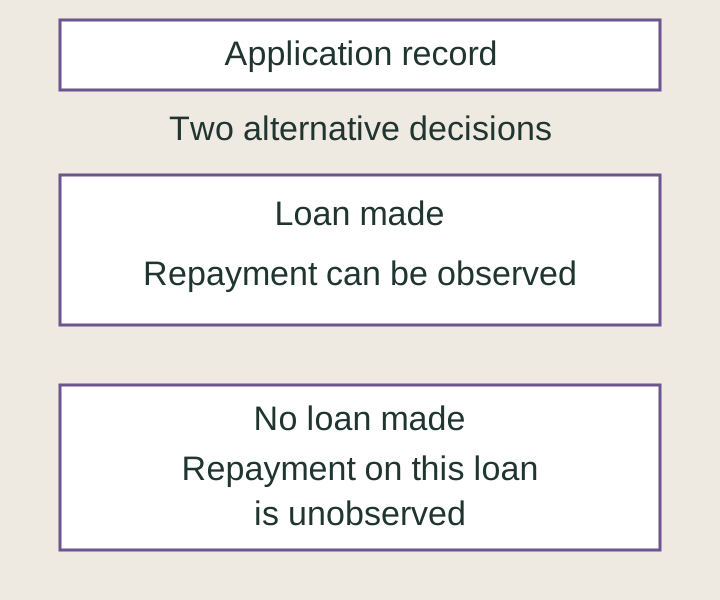
Static explanation shown. Select Play to follow the diagram.
What I report about the COVID portfolio
In my account, the resulting portfolio had a lower default rate than the main portfolio of traditionally banked customers at the same bank, which remains anonymous. The observation period, default definition and differences between the groups are unavailable here. Those gaps prevent me from attributing the difference to the model.
In a separate Caribbean fintech deployment using relatively few data points, I reported a default rate below 2% and a customer base around 90% unbanked.
Look at the choices the customer can make
My Customer Equity Trees presentation describes a way to map possible transitions through a customer relationship. It considers customer characteristics, available choices, the timing of transitions and estimates of value. Product requirements and business restrictions help determine which paths can be offered. The presentation also contains proposed methodology; it should not be read as a record that every component was implemented and validated. [2]
My presentation points to a risk. An offer could increase the firm’s future cash flows by encouraging spending that leaves the customer with more debt. Before comparing possible paths, I would ask the team to name whose financial position it wants to improve.
A different offer changes the question
Consider a teaching example, not a reconstruction of a bank case. A lender rejects an applicant under one proposed repayment schedule. The team then considers whether a different schedule could fit the person's verified circumstances. It must reassess affordability, repayment risk and the customer's understanding of the terms. The original refusal cannot answer those questions on its own.
Nor does finding a plausible alternative prove the applicant should receive the loan. A useful analysis may show that no available offer is affordable. It may reveal missing information that needs to be checked, or a restriction the lender cannot responsibly change. Keeping those outcomes visible prevents a customer-first approach from becoming a presumption that lending is always the right result.
This is how I interpret People First, Problem Second, AI Last in credit work. Begin with the person's need and the decision to be made. Decide what evidence is required, then consider whether modelling can help. The relationship manager, credit officer and model developer need a shared account of the decision, even though their responsibilities differ. [3]
The risk sits with the borrower too
A loan that looks attractive to a lender can still leave a borrower unable to manage essential spending. An inaccurate refusal can deny someone a suitable opportunity. The team needs to examine both harms. Human review is useful only if the reviewer can inspect the evidence, challenge the recommendation and correct the record before the decision takes effect.
More personal information also creates obligations about access and appropriate use. I would ask which facts change the decision and why each is necessary, rather than collect an expanding profile because the technology permits it. A credible explanation should let a customer identify a factual error. A persuasive story generated by an assistant is insufficient if it cannot be traced to the information used.
What I would ask a lending team to inspect
Choose one refusal pathway and trace what happens from the application to the final explanation. Identify which information comes from the applicant, which comes from institutional records and which is inferred. Mark unknowns in the record so that a reviewer can separate missing evidence from a model’s estimates.
Then ask the risk team how it would compare an alternative approach with the current one. It should define default consistently, align the time available for outcomes to emerge and explain differences in customer selection and product terms. Where the comparison remains uncertain, record what additional evidence would change the decision to proceed.
Sources and scope
[1] Kleinberg, Lakkaraju, Leskovec, Ludwig and Mullainathan, Human Decisions and Machine Predictions, Quarterly Journal of Economics, 133(1), 2018. See the selective-labels discussion in the authors’ working paper. Open working paper, p. 8
[2] Adrian Dunkley, Customer Equity Trees v1, author presentation. See the accompanying author-source summary. Purpose, objectives, methodology, work-to-date and ethical-concerns sections inspected. The presentation is a primary account of the proposed approach, not an independent portfolio evaluation.
[3] Adrian Dunkley, People First, Problem Second, AI Last: start with the human need, define the problem, then choose whether AI can help. Adrian Dunkley’s AI Boss manifesto.
Lending figures and outcomes come from my account supplied for this series on 30 October 2026. No independent portfolio audit is presented. Sources checked 6 November 2026.