Opinion · Scientist, Entrepreneur, Businessman
Customer Equity Trees and the choices a lifetime value score hides

Two customers can look identical in a lifetime value report and face very different choices. Customer Equity Trees starts with the paths each customer can take.
A customer's spending can rise while their financial position gets worse. The business can also raise its estimate of what that customer will contribute over the rest of the relationship. I started developing Customer Equity Trees after working on customer lifetime value and asking what the calculation could tell us about the person making the choice.
Keep two ledgers
Customer lifetime value estimates what a relationship contributes to the company over time. The customer has a separate financial position. Their net worth is what they own less what they owe. Cash on hand matters even when net worth stays the same. A business deciding which offer to make needs to see what the customer pays and what the firm earns after the cost of serving them.
Imagine a self-employed customer choosing between J$48,000 for a year of service up front and J$4,500 a month for twelve months. The annual plan costs J$6,000 less over the year and takes J$48,000 out of the customer’s cash on day one. I would ask the analyst to show the first payment and full bill on the customer side, and the expected dates of payment and costs of serving the account on the firm side. If the upfront payment draws down cash the customer needs to pay other bills, ask what they would have to postpone or borrow. The two offers show when the money is due. A projection of future net worth also needs evidence about the customer’s assets and debts.
Put the choices on the page
In my Customer Equity Trees presentation, I proposed mapping the choices a customer could face from their first contact with the business. At each point, list the products the customer can use and the conditions the company sets. Include the option of waiting or leaving if the customer has it. An offer that exists in the catalogue may never appear on the customer's screen.
The proposal also sketches how to estimate which option a customer might choose, when that choice might occur and how the customer's financial position might change. Tests of price and terms can inform the choice estimate. Historic take-up is evidence about the offers people actually saw. A blank for an offer they never received has a different meaning from a recorded refusal. Customer interviews can also surface reasons that transaction data misses, such as how the customer judged a fee or understood a payment schedule.
What a circuit switch changes
In a parallel circuit, each branch connects to the same two points. As OpenStax puts it, “the voltage drop across each resistor is the same”. The current in each branch depends on its resistance. The diagram uses an ideal source that holds its voltage as a switch opens.
Current in a parallel circuit
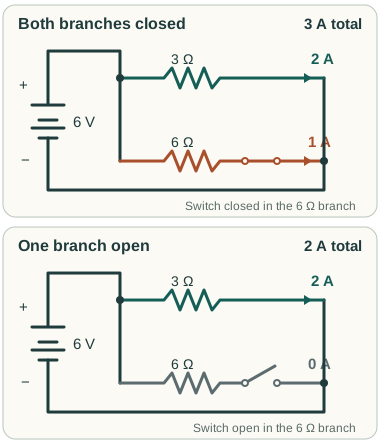
The switch gives us a way to visualise which routes remain available after a rule changes. A customer who loses an option may choose another offer, wait or go elsewhere. Those responses depend on the person's circumstances and preferences. They need evidence from customers.
What the fintech account can tell us
I applied the approach in Caribbean fintech projects. My account of one deployment puts the share of unbanked customers at about 90% and reports a default rate below 2%. The account lacks a cohort count, a follow-up period and a default definition. Those figures describe the portfolio. Estimating the effect of the method would take a comparison with how an equivalent group fared under another approach. I cover a separate bank portfolio in The people a credit model missed.
There’s also a decision about what goes into the tree. A firm might have a record of the prices it displayed and the offers people took. The customer might have debts the firm cannot see. I would leave those amounts unknown. Filling them with a typical value can make one route look affordable on paper while hiding the question the firm needs to ask.
Bring one choice to the next review
At the next pricing review, pick one payment schedule the company can change. Draw what a customer can do today and add one route the team could test. My Understand Your Customer method starts with the person facing the choice. Ask a customer when they need the cash and what they understood about the full bill. Ask finance to price the cost of servicing the new route. Mark take-up as unknown until the offer has been tested. Give one person ownership of the decision and a date to bring back those answers.
Sources and related reading
The research proposal is described in my Customer Equity Trees source note. For the firm-side definition, see Rust, Lemon and Zeithaml, Return on Marketing. The circuit follows OpenStax Physics, section 19.3. The AI Boss HQ guide uses a booking example to show how a team can test a new path. Kill My Startup sets out how I challenge assumptions about who will pay. StarApple AI describes the consulting work behind some of these questions.