![[Merchants' Carnival Portrait: Electric Light Bulb Purveyor, Chardon, Ohio], gelatin silver print by Henry Carlton Wilber](../images_blogs/art/caribbean-ai-forum-2026-trinidad-data-center-rules.jpg)
Henry Carlton Wilber, [Merchants' Carnival Portrait: Electric Light Bulb Purveyor, Chardon, Ohio], 1880s–1890s. The Metropolitan Museum of Art, public domain.
On July 11, 2026, the Trinidad and Tobago government signed memorandums of understanding with Hummingbird AI Holdings of Florida and Ernst and Young LLP of New York. They lay groundwork for a proposed 150 megawatt AI infrastructure facility and a 300 megawatt data centre. Prime Minister Kamla Persad-Bissessar presented them, alongside a steel industry deal, as bringing more than 5,000 jobs.
Twelve days later, the Caribbean Telecommunications Union brings ministers, regulators, academics and civil society to the University Inn Conference Centre at UWI St Augustine for the first Caribbean AI Forum. There the region's AI Task Force releases the governance framework it has spent nine months building. I have worked on AI capacity in this region for close to two decades, and this order usually ends the same way: the facility is built to the standard the buyer wanted, and the governance review arrives after the concrete is poured.
![[Thatched House, People in Foreground, Telegraph Lines in Background], albumen silver print from glass negative by Unknown](../images_blogs/art/caribbean-ai-forum-2026-trinidad-data-center-rules-2.jpg)
Unknown, [Thatched House, People in Foreground, Telegraph Lines in Background], 1860s–70s. The Metropolitan Museum of Art, public domain.
The two MOUs commit to negotiation, not construction
The Hummingbird AI Holdings agreement sets up "preliminary cooperation, due diligence and coordination" toward a 150 megawatt facility. The Ernst and Young agreement is a framework for collaboration on a 300 megawatt data centre, with the firm planning to bring in third-party partners. Neither commits anyone to build.
That makes this the stage where terms get written in or left out. The 5,000-jobs figure covers three initiatives, including the revival deal with Pinnacle Steel and Vanadium Corporation, so it is not a data centre figure. Nobody audits employment numbers at the due-diligence stage.
Nothing reported publicly so far shows a water allocation ceiling, an energy-source requirement or a duty to disclose either facility's consumption once it is running.
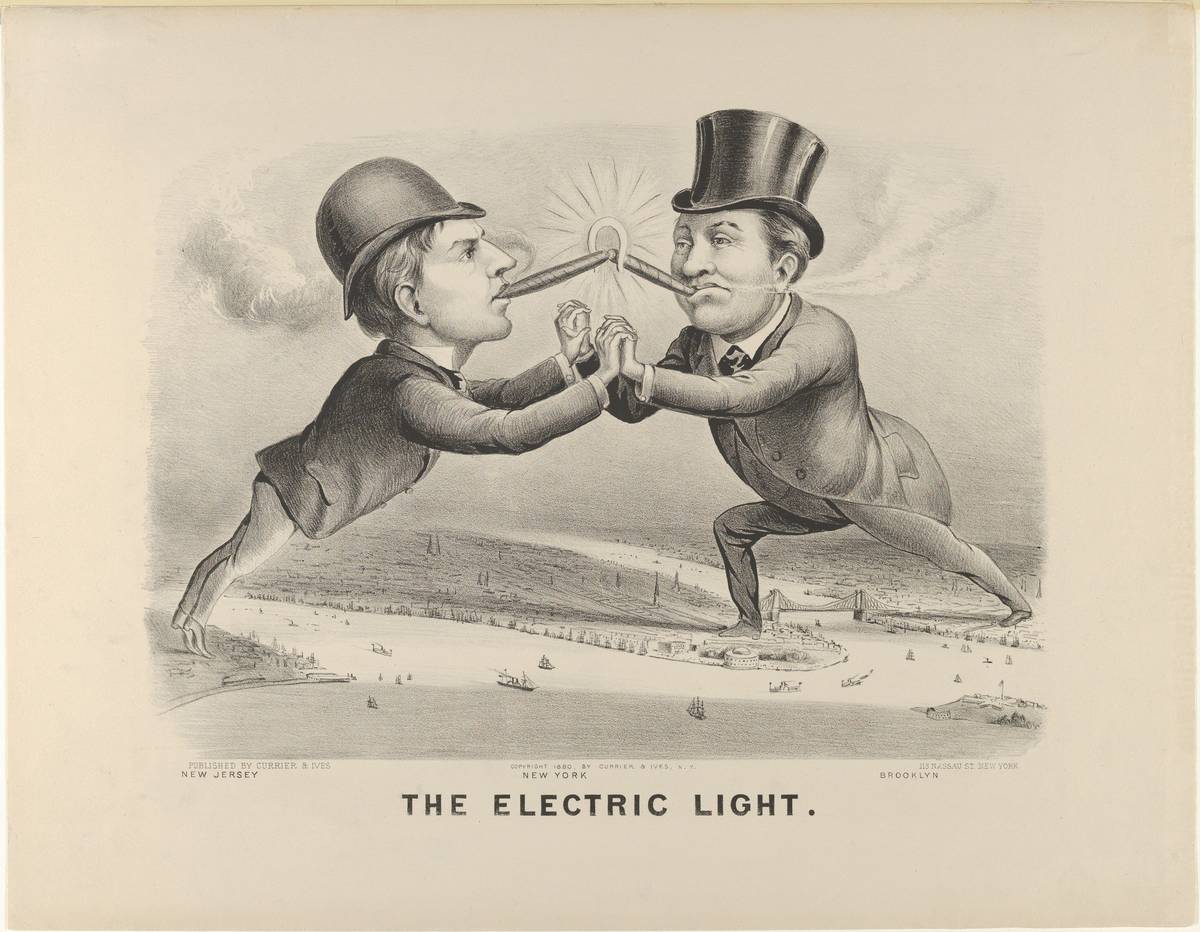
Currier & Ives, The Electric Light, 1880. The Metropolitan Museum of Art, public domain.
Water and power are the terms that matter most
Much of Trinidad and Tobago is on scheduled piped water from the state utility, and some communities get supply as rarely as once a week. Household water tanks are standard fittings. Social activist Dr. Wayne Kublalsingh has called the announcements something that "looks like development, but which is not development," pointing to the energy and water load such facilities add.
A combined 450 megawatts is a large load for any grid. Cooling can add a heavy water draw, depending on design: evaporative cooling uses far more water than closed-loop or air-cooled systems. Industry projections cited in coverage of the deal put global data centre electricity use at 935 terawatt-hours by 2030, close to 3 percent of world consumption. Whether these facilities are air-cooled or water-cooled is the design decision a framework should settle before signing, and no public document yet says which it will be.
What the Task Force framework recommends
The Caribbean AI Task Force was set up under a mandate approved at the CTU's 31st General Conference in October 2025. It has more than 35 experts from governments, universities, civil society and business. Its interim findings describe a "connectivity paradox": high digital engagement on top of fragile infrastructure, expensive connectivity, fragmented national regulation and weak data governance.
Its recommendations, due for full release with an implementation roadmap at the Forum:
- A CARICOM-wide AI governance framework built on model laws that member states adapt instead of drafting from scratch.
- A Caribbean Data Commons, so the region shares infrastructure instead of running many thin national efforts.
- Targeted support for AI in agriculture, disaster management, tourism, finance, health and public administration.
- Investment in AI literacy and training aimed at the brain drain that pulls trained people out of the region.
- The Forum as an annual platform, not a one-off event.
The agenda covers human-centred AI ethics, data sovereignty, cybersecurity and intellectual property, plus a Women in AI session, a youth debate on workforce development, climate resilience and an economic transformation roundtable. Julie Koon Koon, lead data scientist at Republic Bank and a data science lecturer, is among the confirmed speakers.
The Sequence, By the Numbers
- 450 MWCombined AI data centre capacity under MOU in Trinidad and Tobago (150 MW Hummingbird AI Holdings, 300 MW Ernst and Young)
- July 11, 2026Date the data centre MOUs were signed
- July 23–24, 2026Dates of the first Caribbean AI Forum, UWI St Augustine, Trinidad and Tobago
- 35+Experts on the CTU Caribbean AI Task Force behind the governance framework
- 1.12%Share of global AI investment received by Latin America and the Caribbean, against 6.6% of global GDP (ECLAC-CENIA, Oct. 2025)
- 935 TWhProjected global data centre electricity use by 2030, about 3% of world consumption
Why governments sign first
The ECLAC-CENIA Latin American Artificial Intelligence Index, published in October 2025, found that the region produces 6.6 percent of global GDP and receives 1.12 percent of global AI investment. No country in Latin America or the Caribbean reaches the world average for AI investment relative to GDP per capita, and the regional average is about six times below it. When two international firms bring 450 megawatts of interest, a government under that kind of shortfall will take the meeting.
That explains the order; it does not make it safe. A region short of investment has the least room to renegotiate once a facility is built and the jobs are counted, so it needs its terms fixed before the first large offer. The Task Force itself warns that Caribbean nations risk becoming passive rule-takers in a consolidating global AI market.

Robert Charles Dudley, Trinity Bay, Newfoundland: Exterior View of the Telegraph House in 1857–58, 1865–66. The Metropolitan Museum of Art, public domain.
A model that ran ahead of the deals
UWI's Institute for Intelligent Systems Governance and Human-Centered Technology, I-INSIGHT, launched in May 2026 with a five million dollar investment from Sagicor Financial Corporation. Its first arm, the Sagicor UWI AI and Financial Services Hub, starts rolling out across UWI campuses in August, with hubs for tourism, agriculture, healthcare, climate resilience and public administration to follow. A private company and a regional university are building governance and technical capacity before any single deal forces them to, on the same campus that hosts the Forum.
The Forum needs to produce four things a government can use:
- A model AI governance law member states can adapt in months.
- A binding disclosure standard for water and energy use on any data centre above a stated capacity threshold, published before ground is broken.
- A public tracker that measures every new infrastructure agreement against the framework.
- A named regional body, with staff, that governments can call on to review an MOU before signing.
I am less certain about the fourth. A review body only works if governments agree to wait for it, and I have not seen a Caribbean government accept a delay on a large investment for a regional opinion. That is the weak point in my own proposal.
"A country with a weekly water schedule signing 450 megawatts of AI infrastructure before the region has a rulebook is not a scandal. It is what chronic underinvestment does to a government's patience. The Forum's job is to make sure it never has to happen that way again." - Adrian Dunkley, AI Boss
What to do next
- Trinidad and Tobago government negotiators, before any MOU becomes a contract: require the developers to state peak megawatt demand, cooling method, annual water draw and water source in writing, and publish those figures.
- WASA and T&TEC: each publish an assessment of whether current supply can carry the proposed load without cutting household allocations, before any site is approved.
- CARICOM ministers attending the Forum: commit to a date for tabling the Task Force's model AI law in their own parliaments, with the first readings targeted within 12 months.
- The CTU: publish a one-page data centre checklist (power, water, cooling, jobs, data jurisdiction, exit terms) that any member state can use at the MOU stage.
- Civil society groups and journalists: request the full MOU texts and track each against the Task Force framework once it is released.
Frequently Asked Questions
Is a memorandum of understanding legally binding?
Usually not, in its main commitments. An MOU records an intention to cooperate and often sets out due diligence and exclusivity periods, but the binding obligations come later in the investment, land, power and water contracts. That is why the terms that matter can still be added, as long as they are raised before those contracts are drafted.
What figures should a data centre developer be required to disclose?
At a minimum: peak power demand in megawatts, expected annual electricity use, cooling method, annual water use and its source, and power usage effectiveness (PUE), which compares total facility energy with the energy used by the computers. Water usage effectiveness (WUE), measured in litres per kilowatt-hour, is the matching water metric. Ask for design figures and a commitment to report actual figures each year.
Where does Trinidad and Tobago's electricity come from, and why does it matter here?
Almost all of Trinidad and Tobago's electricity is generated from natural gas. A data centre running on that grid would add to gas demand and to the country's emissions, and would compete with petrochemical exports for the same gas. Any agreement should say whether the developer will bring its own renewable supply or draw from the existing grid.
Which Trinidad and Tobago agencies would review a data centre project?
Several would be involved. The Environmental Management Authority handles environmental clearance for designated activities, WASA supplies water, T&TEC supplies and transmits electricity, and the Regulated Industries Commission regulates utility rates and service standards. Planning approval sits with the Town and Country Planning Division. Check each body's current requirements, because a project of this size may need approvals from all of them.
How can the public follow what happens to these deals?
Watch for the MOUs being converted into project agreements, applications for environmental clearance, and any tabling in Parliament. Freedom of information requests can be made for documents held by public authorities under Trinidad and Tobago's Freedom of Information Act. The Task Force framework, once released, gives a checklist to compare the deals against.